
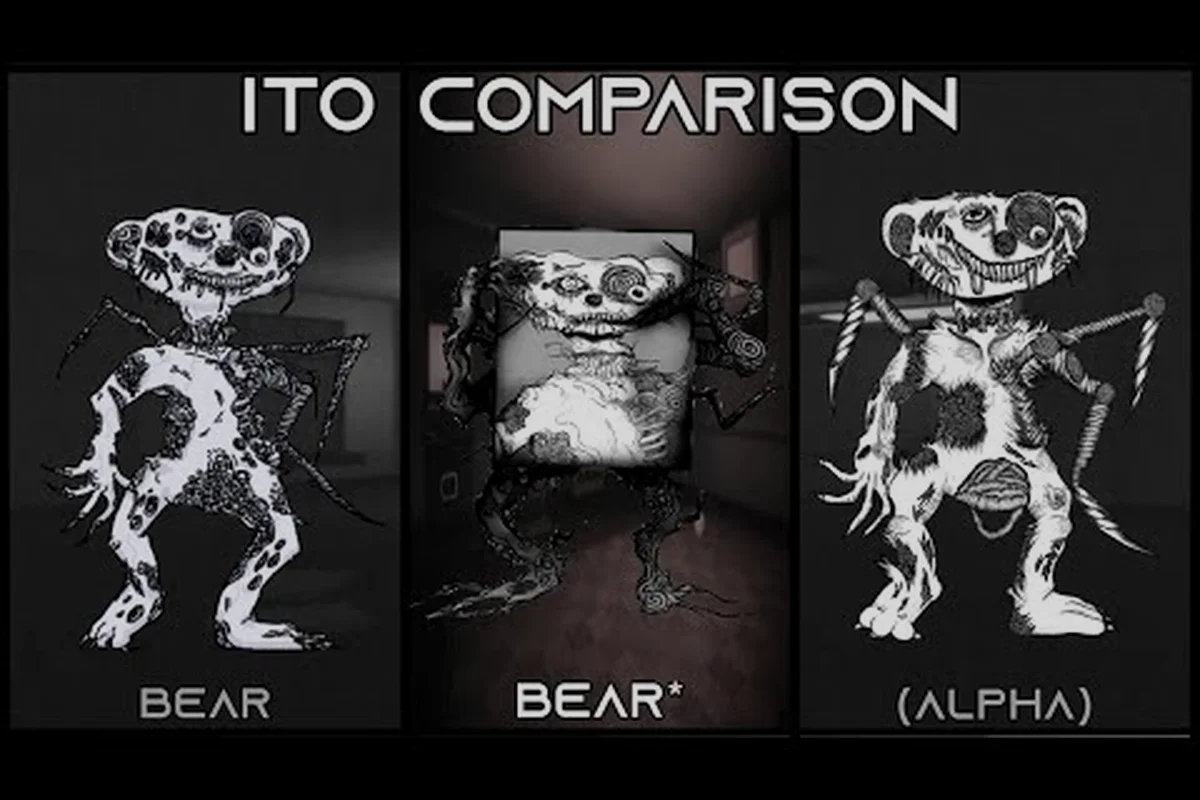
Comparing bear alpha vs bear star matters because the two Roblox experiences share a name and visual identity, yet present different stories, monsters, maps, and player interpretations. Community comparisons and developer messages can help separate confirmed material from fan theory while revealing how each version turns the same premise into a distinct experience.
Bear Alpha vs Bear Star: The Core Difference
The clearest way to understand bear alpha vs bear star is to treat them as related horror experiences rather than as interchangeable releases. BEAR Alpha centers on a controlled asymmetric survival loop, recurring mission structures, and the dread associated with Ito. BEAR* takes a different creative direction, drawing attention to mystery, comparison videos, and the idea of an alternate or expanded interpretation.
That distinction matters because the shared title does not guarantee shared continuity. A monster appearing in both games can still represent a different entity if the surrounding fiction, objectives, and presentation change. Likewise, a familiar building, radio message, or visual error may carry more meaning in one version simply because the other version provides a different context.
| Comparison Point | BEAR Alpha | BEAR* | What the Difference Means |
|---|---|---|---|
| Primary presentation | Structured asymmetric horror gameplay | A separate mystery-focused BEAR experience | Similar imagery can support different stories |
| Best-known creature | Ito, the pursuing monster | Often discussed through comparisons with BEAR Alpha’s creature | Names do not automatically establish identity |
| Player role | Survivor pursuing reports while avoiding danger | Determined by the specific BEAR* experience | Goals change how clues are interpreted |
| Evidence style | Objectives, rounds, radio, maps, and environmental details | Community footage, theories, and visual comparisons | Some evidence is playable; some is interpretive |
| Lore status | Mix of developer material and player interpretation | Community-led comparison and interpretation | Confidence should be labeled separately |
The comparison is strongest when it focuses on evidence rather than names. In BEAR Alpha, the encounter with Ito and the need to complete reports create an immediate story engine: each round forces players to move through a dangerous space while gathering information. In BEAR*, the appeal comes more heavily from discovering what the experience is depicting and how its imagery relates to BEAR Alpha.
A community video titled Ito Comparison | BEAR (Alpha) vs BEAR* is useful for visual comparison, but its observations should be treated as player analysis rather than official confirmation. It can show visual parallels, editing choices, and the way one community member connects the two games. It cannot, by itself, prove that the developers intended every shared element to be part of one continuous canon.
Shared Symbols, Different Context
A shared monster silhouette, dark forest, damaged technology, or sudden pursuit does not automatically establish a shared fictional universe. The context changes the meaning. A creature chasing a player through a mission map is a mechanical threat first; the same image in a disconnected cinematic or cryptic environment may function more like a symbol or anomaly.
The practical rule is simple: appearance suggests a connection, while progression proves context. Before linking two monsters, check whether their behavior, objectives, audio, and locations support the same role. A parallel image can become lore evidence only when several independent details point in the same direction.
Monsters, Myth, and Ito’s Place in BEAR Alpha
Ito is central to BEAR Alpha because the game turns the act of being hunted into its primary narrative pressure. The monster does not merely punish failure; its pursuit gives every survivor a reason to prioritize escape, communication, and incomplete reports. That makes the creature’s behavior part of the story even when no cutscene explains its origin.
The broader BEAR Alpha mythology has sometimes mixed the monster’s official identity with player-created creepypasta. This makes bear alpha lore explained a process of sorting categories. The game can confirm what Ito does in a match, while the playerbase may debate whether the creature represents an experimental subject, a supernatural entity, a former human, or a deliberately undefined anomaly.
| Lore Claim | Evidence Type | Confidence | Best Interpretation |
|---|---|---|---|
| Ito pursues survivors | Directly observable gameplay | High | Confirmed monster function |
| Ito has a recognizable silhouette | Visual gameplay evidence | High | Confirmed visual identity |
| The monster has a fixed origin story | No conclusive source supplied here | Low | Treat as theory |
| BEAR Alpha shares a canon with BEAR* | Primarily visual and community comparison | Low to moderate | Possible thematic connection |
| Developer messages confirm every theory | Only specifically verified posts support this | Low | Never infer blanket confirmation |
This is why a bear alpha full lore reading needs labels. Use confirmed for information visible in the game, reported for accounts shared by players, and interpretive for theories that connect separate clues. The labels prevent a compelling theory from becoming a false statement simply because it has been repeated often.
The developer’s verified X account is especially important for checking current announcements and event information. It should not be mined for confirmation of every fan theory. A post about an event, update, or seasonal feature proves that the post’s subject exists; it does not automatically validate a broader conclusion about the creature’s origin or the relationship between the games.
Ito’s Chase as Evidence
The chase contains narrative data in its form. Survivors learn what attracts danger, how much space they can create, and which routes become unsafe when the round changes. That knowledge lets experienced players describe the monster’s behavior with more precision than a general claim that the bear is “unfair.”
For lore analysis, separate three layers: what Ito visibly does, what the mission environment suggests, and what survivors infer from the chase sequence. For example, if Ito repeatedly blocks the same escape corridor while the Bear Star changes its movement pattern, that contrast can support a mechanical comparison without proving that BEAR Alpha, the Cheedaman, or a developer message confirms a shared origin. This distinction prevents visual similarity between BEAR Alpha and BEAR Star from being treated as proof that one entity is secretly the other.
-
Mechanical behavior describes what Ito does during a match.
-
Environmental behavior describes what maps, props, and mission spaces imply.
-
Narrative interpretation describes what players believe those facts mean.
The first two layers can be verified through play. The third remains open unless supported by reliable developer statements or a clear narrative sequence. The broader BEAR Alpha origin analysis provides useful context for separating those layers without treating the central mystery as completely solved.
Maps, Missions, and Narrative Progression
Maps provide much stronger evidence for bear alpha lore timeline because their locations, objectives, and changing conditions can be observed across the experience. The mission structure also explains why lore is distributed rather than delivered in a single cutscene. Players encounter details while trying to gather reports, hunt targets, or reach a dig site, so environmental storytelling competes with immediate survival pressure.
| Narrative Layer | Player Experience | Lore Contribution | Reliability |
|---|---|---|---|
| Report system | Survivors collect and submit evidence | Shows the expedition’s working structure | High |
| Mission locations | Targets, routes, and dig sites establish spatial context | Shows where events occur | High |
| Round escalation | Conditions intensify as players survive | Suggests an active threat rather than a static display | High |
| Radio and environmental text | Fragments appear during play | Adds context but may remain ambiguous | Medium to high |
| Cosmetic storytelling | Skins, props, and event art imply a broader world | Useful for atmosphere, weaker for canon | Low to moderate |
The available material does not provide one clean, date-by-date release chronology that fully explains the entire story. A responsible bear alpha lore timeline therefore follows the game’s internal progression first: early mission rounds, later escalation, event additions, and developer communications. Patch dates can then be placed around that internal order without pretending that release order alone explains the fiction.
This distinction protects against a common error. When BEAR Alpha receives an event map, new skin, or developer announcement, the addition may establish when a detail became visible, but not when the event takes place inside the story. A holiday event can exist outside the central timeline, while a recurring map object may imply that the expedition has continued across multiple operations.
Starting With Observable Placement
Start with observable placement. Which objectives sit near power systems, shelters, vehicles, or damaged communications? Which spaces remain inaccessible? Does the route force survivors toward one another, thereby making the monster’s presence a tool rather than simply a wandering hazard?
Next, compare repeated layouts. A location used in several rounds is more likely to represent part of the recurring expedition than a disposable event corridor. Compare the Bear Alpha decoded hints overview for a framework that connects environmental details without assuming that every ambiguous symbol has one intended answer.
Finally, separate chronology from geography. A radio message may indicate that a rescue attempt failed, but it does not automatically establish whether the message came before or after a particular mission. Map geography can help infer relationships; timestamps and objective changes provide the stronger timeline evidence.
BEAR* Connections and the Limits of Visual Evidence
BEAR* draws attention because players can recognize BEAR Alpha motifs in its presentation and connect them to a separate storyline. That is the basis of many bear alpha vs bear star theories, but visual resemblance is only the first stage of analysis. The stronger the evidence, the less speculative the connection becomes.
| Evidence Level | Example | Reasonable Conclusion |
|---|---|---|
| Shared asset shape | A similar creature outline | Artists may reuse a visual motif |
| Matching color and texture | Same palette and surface treatment | Stronger visual relationship |
| Same location layout | Repeated rooms, paths, or landmarks | Possible direct map connection |
| Matching mission logic | Comparable objectives and failure states | Shared design language |
| Confirmed developer statement | Explicit reference to both games | Official relationship, if accurately quoted |
| Player montage | Edited juxtaposition | Hypothesis worth testing, not canon |
This framework prevents a common analytical mistake: stacking several weak similarities until they resemble certainty. A montage can make two images feel adjacent, but it cannot manufacture missing context. The creator of that comparison video may have noticed meaningful parallels, yet an edited comparison remains community interpretation until the developers confirm a relationship.
The key question is not whether BEAR* “copied” BEAR Alpha. That framing assumes a single direction and requires evidence about production history. It is more productive to ask whether BEAR* reuses assets, expands the premise, creates a parallel version, or was assembled from familiar BEAR motifs for an entirely separate purpose.
What a Direct Connection Would Require
A convincing theory of a direct narrative link should combine several kinds of evidence. Matching geography should align with matching rules, such as a repeated destination and equivalent objective. A recurring creature should behave consistently across both games. Audio, symbols, and mission text should reinforce the same explanation.
Without that chain, the responsible conclusion is that BEAR* references or resembles BEAR Alpha. It may be an alternate branch, a thematic successor, or an independent interpretation. The evidence currently established here does not justify choosing among those labels as fact.
Developer Messages and Cheedaman Lore
The verified developer account for Cheed provides one of the strongest external checks on BEAR Alpha’s public communication. Posts about anniversary content, events, and updates can establish what the developer has actively presented to the community. However, bear alpha cheedaman lore also includes a danger: turning every cheerful social-media post into hidden evidence about the game’s darkest mythology.
| Developer Material | What It Can Confirm | What It Cannot Confirm Alone |
|---|---|---|
| Event announcement | Event timing, rewards, or featured content | Complete event storyline |
| Update notice | A feature or fix is planned or released | The final meaning of related imagery |
| Community reply | The developer discussed the topic in that context | Details omitted from the post |
| Social-media joke | The tone of a public interaction | A hidden narrative explanation |
| Long-form devlog | Stated intentions and design context | Clues the developer did not mention |
Bear alpha developer secrets should therefore be framed carefully. Genuine secrets are confirmed omissions, deliberately obscured mechanics, encoded references, or official statements that reveal less than players initially assumed. A fan theory is not a developer secret merely because it has not been formally denied.
For anyone building bear alpha developer messages into a chronology, record the exact date, visible wording, media attached, and whether the post has since been edited or deleted. A screenshot without its surrounding conversation can change meaning. A humorous reply can become a serious clue when removed from context, and an announcement can be mistaken for a lore confirmation when it only describes a cosmetic event.
The developer’s public posts are most useful as a boundary-setting tool. They tell us what has been promoted, confirmed, or teased. The Bear Alpha creepypasta history explains how community horror narratives grew around such gaps, while also showing why a social-media clue and a copied forum story should not be merged into the same evidence category.
Turning Posts Into a Reliable Record
A useful developer-message record contains five fields that help separate the bear alpha signal from bear star clues: record the original timestamp, preserve the message verbatim, include attached media, link the relevant reply or event, and note whether the post is still public or was edited. This matters because a deleted or altered developer post may lose its original context; an archived copy preserves the evidence used when comparing the bear alpha lore timeline with the bear star announcements and earlier bear alpha developer secrets claims.
| Field | Why It Matters |
|---|---|
| Date and time | Establishes release and announcement order |
| Exact wording | Prevents memory or summary errors |
| Attached media | Captures images, clips, or text not present in the post |
| Context | Shows the question, reply chain, or event being discussed |
| Status | Notes whether it remains public or was changed |
This method makes the bear alpha lore timeline reproducible because each claim can be checked against the original developer message, its attached media, and its place in the relevant bear star announcement sequence. For example, if a post links to an earlier bear alpha developer secrets claim, preserving the exact wording and reply context lets readers test whether the later statement confirms, revises, or merely echoes that clue. Timestamps and public-status notes also expose possible ordering or editing issues, helping distinguish an intentional signal from routine event promotion or an uncited fan inference.
A Method for Comparing the Two BEAR Experiences
A reliable bear alpha vs bear star comparison should separate confirmed BEAR ALPHA details from visual guesses, then test each observation against the bear alpha lore timeline, developer messages, and cheedaman lore. For example, a matching silhouette or color palette can support identification, but it cannot confirm a developer-secret claim without a traceable message or documented event; this prevents bear alpha full lore and bear alpha developer secrets pages from treating resemblance as evidence.
Step 1: Record the Observable Difference
Build a two-column observation log for BEAR Alpha and BEAR*, recording what the game actually presents before interpreting any “lore.” Compare enemy designs, mission objectives, map layouts, HUD elements, sound cues, failure states, and trailer or store-page claims; for example, note whether Alpha’s chase sequences use distinct audio warnings from BEAR*’s level-based encounters. Mark each feature as Alpha-only, BEAR*-only, or shared, and flag uncertain details rather than treating promotional framing as confirmed developer evidence.
Step 2: Identify the Source Type
Classify every claim as an in-game observation, official communication, community report, or interpretation. Official material should be cited precisely, while community reports should include the version or event date when possible. Do not cite a theory video as proof of the fact it argues.
Step 3: Test the Connection
For every proposed link, ask whether the same interpretation explains the monster, setting, and objective. Remove any link that only looks striking in isolation. The strongest bear alpha lore timeline is one that explains several details without requiring a separate assumption for each one.
Step 4: Record Disconfirming Details
In a Bear Alpha versus Bear Star comparison, treat contradictions as evidence rather than footnotes: one version may change the creature’s attack pattern, while the other preserves a different damage window or movement rule. If the games use different mission objectives, check whether “destroy” means eliminating the target directly or forcing it into another state; these rule differences can explain why identical-looking encounters play differently. Record each mismatch beside the shared feature, then note whether it comes from a mission script, an animation, or a design revision. A table of creature behavior, mission requirements, and visual details is more useful than a list of similarities, because it exposes which differences actually change the player’s strategy.
Step 5: Label the Confidence
Use a simple scale so readers can understand the result without mistaking community enthusiasm for canon. For example, a visual match between BEAR* and BEAR might support a “Plausible” label, while a recurring BEAR* behavior across multiple developer messages could justify “Strongly supported”; only direct gameplay footage or an explicit developer statement should earn “Confirmed.”
| Label | Meaning | Appropriate Evidence |
|---|---|---|
| Confirmed | Directly shown in a game or explicitly stated | Official gameplay, clear developer statement |
| Strongly supported | Multiple independent clues agree | Repeated map, audio, and behavior evidence |
| Plausible | A reasonable connection with incomplete support | Visual parallels or player testimony |
| Speculative | Creative interpretation | Unverified rumor or lore theory |
| Contradicted | Evidence directly conflicts with the claim | Conflicting mechanics or official information |
This method works because it makes uncertainty productive. A reader can accept the confirmed foundation, evaluate the speculative extension, and decide whether new developer messages change the conclusion. It also preserves the possibility that BEAR* is related without requiring a direct narrative sequel.
Practical Conclusions From the Evidence
The safest conclusion is that BEAR Alpha and BEAR* share recognizable design language but should not be treated as automatically identical stories. BEAR Alpha provides a concrete survival framework built around reports, missions, escalating pressure, and Ito. BEAR* invites comparison through its presentation and community interpretation, but the available evidence does not automatically establish a shared canon or confirm every proposed connection.
The most valuable primary source in the supplied material is the developer’s verified X account. It can confirm public announcements and changes, yet it cannot retroactively validate every fan theory. Community videos remain valuable for visual analysis because they reveal what players notice, but their conclusions should remain labeled as interpretation unless supported by the game or the developer.
For bear alpha full lore discussions, the same discipline applies. Separate the chase from its alleged origin, the report system from broader institutional claims, and release history from in-story chronology. That produces a smaller set of firm facts, but those facts remain more useful than a seamless account built from unverified links.
The comparison ultimately reveals two related experiences rather than one simple answer. BEAR Alpha uses Ito and the mission loop to make danger part of every narrative beat; BEAR* appears to operate as a separate expression of the BEAR premise that players interpret through repeated imagery and direct comparison. Any stronger claim needs more than resemblance: it needs a consistent chain of evidence across behavior, setting, progression, and developer communication.
Frequently Asked Questions
Are BEAR Alpha and BEAR the same game?* No. Although both Roblox experiences use BEAR branding, they are separate releases with different gameplay structures: BEAR Alpha emphasizes asymmetric survival objectives and encounters with Ito, whereas BEAR* focuses on mystery exploration. For “bear alpha vs bear star,” treat Ito, mission progression, and the asymmetric chase loop as Alpha-specific evidence; use BEAR* mystery clues and environmental storytelling as a separate comparison set unless an official developer statement explicitly links the two.
They are distinct Roblox experiences that share BEAR branding and recognizable visual motifs. BEAR Alpha is centered on a structured asymmetric survival loop featuring Ito, while BEAR* is a separate mystery-focused experience. Shared imagery suggests comparison or possible thematic influence, but it does not by itself prove a direct story connection.
Is Ito confirmed as the monster in BEAR Alpha?
Ito is the name associated with BEAR Alpha’s pursuing monster and can be observed through the game’s creature design and chase behavior. His broader origin is not established by the evidence cited here. Claims that identify him as a specific experiment, former person, or supernatural being should be treated as interpretation rather than confirmed biography.
Do developer messages confirm that BEAR is part of BEAR Alpha’s lore?* No explicit developer message cited here confirms that BEAR* belongs to BEAR Alpha’s canon. BEAR Alpha lore—particularly Ito’s identity, mission progression, and the asymmetric chase loop—should be treated separately from BEAR*’s environmental storytelling, mystery clues, and exploration objectives unless the developers make a direct narrative statement linking both experiences.
No blanket confirmation is established by the supplied sources. The developer’s verified account can confirm announcements, event details, and stated design information, while community videos document how players interpret visual parallels. A direct narrative connection would require an explicit official statement or a consistent chain of evidence across both experiences.
What is the best way to build a BEAR Alpha lore timeline?
Begin with observable in-game progression, including mission structures, map use, objective changes, and round escalation. Then add dated developer posts and verified event announcements as the public timeline. Keep release chronology separate from the fictional chronology, since an event released in a particular season does not automatically occur at that point inside the story.
Which comparison evidence is most reliable?
In-game observations and explicit developer statements are the most reliable sources. Community footage and player reports can reveal visual parallels or reported experiences, but they remain secondary evidence unless the developer confirms the same point. The best analysis compares multiple details rather than relying on a single shared asset or edited montage.