
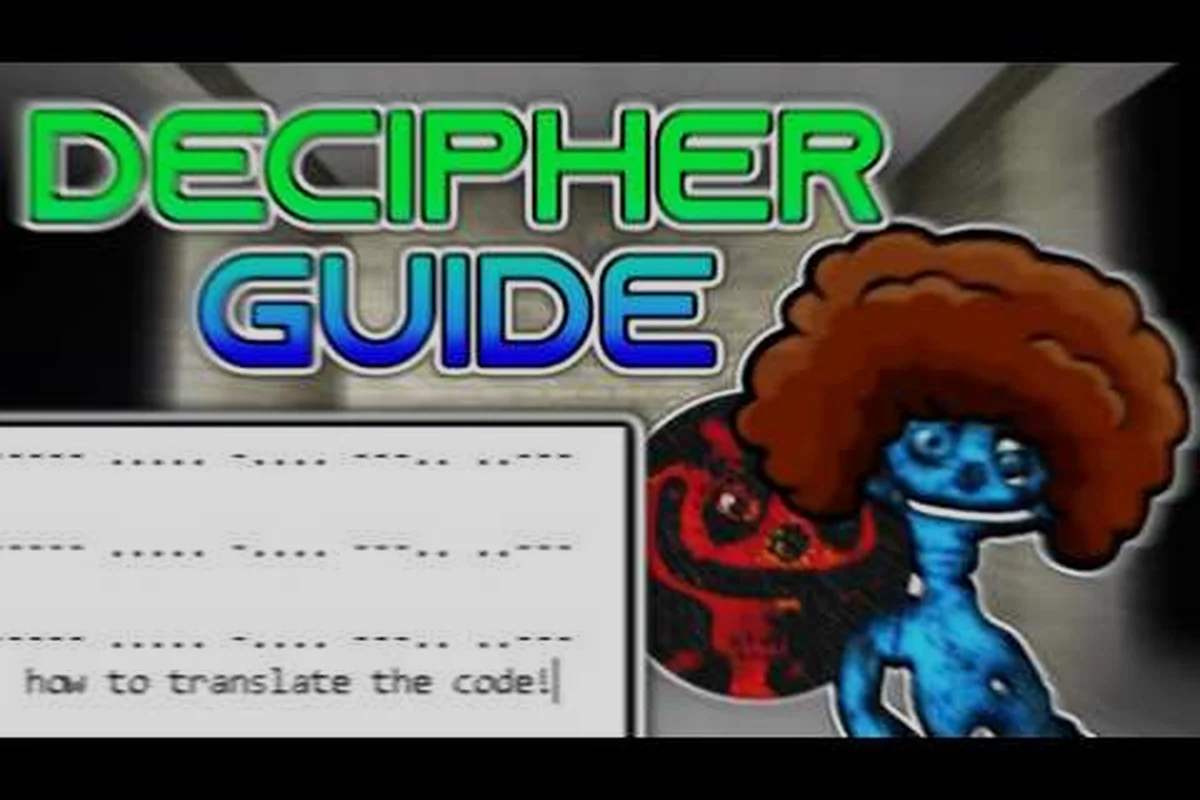
BEAR alpha decoded hints matter because the posters, radio fragments, and strange labels only reveal the game’s larger mystery when they are read as one connected evidence trail. This guide breaks down the AFROCITY code, compares its possible readings, and separates useful clues from the most tempting but unsupported community theories.
BEAR Alpha Decoded Hints and the AFROCITY Code
The AFROCITY message is the central entry point for BEAR alpha decoded hints. A community breakdown from ThrustQL, titled How to Decipher the AFROCITY Code, presents a structured decoding method based on player experimentation rather than an official developer statement. That distinction matters: the guide is useful for understanding what many observers believe the symbols mean, but its conclusions should still be treated as community interpretation.
Players commonly approach the problem by treating the visible letters as an initial layer, then comparing the code with repeated environmental writing, radio wording, and poster imagery. The strongest interpretations do more than assign a single English word to the symbol; they also explain why the same clues recur in different parts of the map.
| Clue type | What players observe | Reasonable interpretation | Confidence |
|---|---|---|---|
| AFROCITY lettering | An unusual multi-letter label | A cipher or encoded warning | Medium |
| Repeated posters | Similar graphics paired with altered text | A deliberate message sequence | Medium |
| Radio fragments | Broken phrases interrupted by static | Recovered transmission data | Medium |
| Matching symbols | Repeated marks in separate locations | A shared classification or identity | Medium |
| Full sentence reading | Letters appear within a broader grammatical context | An acrostic or ordered extraction | Low to medium |
How the code fits into the evidence
The code should be treated as a layered evidence problem. First, separate direct observations from interpretation: the characters, placement, color, repetition, and nearby text are observable, whereas the claim that they name a creature or event is interpretive. Next, compare every appearance. If a symbol occurs on a poster, a radio transcript, and a location label, the shared feature probably matters because designers rarely repeat that exact combination without purpose.
Several BEAR alpha cryptic messages also contain ordinary fragments that can function as a crib. A player does not need a perfect translation from the start; a familiar word near the strange sequence may reveal the ordering rule. This is similar to solving a partially filled puzzle because one reliable anchor can establish whether the letters are being read forward, backward, or by position.
A practical decoding sequence
-
Record every AFROCITY occurrence without guessing its meaning.
-
Mark the surrounding location, image, and nearby words.
-
Compare identical symbols across separate clues.
-
Test the simplest extraction rules before inventing a more elaborate story.
-
Write down which observations support the resulting interpretation.
This process matters because the rule and the meaning are different layers. A working rule can identify a hidden phrase, but confirming that phrase still requires a second clue or a plausible fit with the map’s story.
Bear Alpha Poster Secrets and Radio Messages
The most visible bear alpha poster secrets are not necessarily the most revealing ones. Posters establish the visual grammar of the lore: repeated people, altered faces, storage labels, warning symbols, and text that seems to have been edited or covered. Radio messages add a temporal layer, suggesting that events were recorded before, during, or after the main encounter.
A useful lore-reading method is to build a matrix in which each source is represented by what it shows, what it says, and what it omits. The omission is often the strongest clue because official-looking material usually has a purpose, and a strange gap may indicate censorship, unreliable narration, or a deliberate change in identity.
| Source | Visible information | Implied information | Key question |
|---|---|---|---|
| Warning poster | A threat or prohibited subject | The danger was recognized in advance | Why is the warning incomplete? |
| Radio transmission | Fragmented wording | Someone attempted to report or warn others | Which words were lost? |
| Location label | A repeated designation | The place may have been administratively classified | Does the label match the code? |
| Altered portrait | Changes in imagery | A person or record was modified | What was removed? |
| Final-hour scene | Actions and environmental response | The event escalated under specific conditions | Which earlier clues foreshadow it? |
Reading posters as a sequence
A poster should not be interpreted in isolation. Compare its border design, font, damage, and character arrangement with earlier materials. If two posters share a layout but differ in one figure, the changed figure may be the message. If the text is identical while the image changes, the image may carry the warning instead.
Community reports also describe edited or obstructed wording in several environmental clues. That observation is significant, but it still needs care: a blurred word may represent a missing file, a rendering issue, an animation state, or an intentional narrative edit. For the bear alpha meaning explained by the poster trail, players should note the exact screen and context before drawing conclusions.
Treating radio interruptions as evidence
Radio clues are valuable because they provide sequence, not just setting. Static can represent damaged audio, but it can also separate a warning from a later correction. Look for repeated words before and after the interruption because matching language may reveal that two transmissions were recorded at different times.
The BEAR Alpha lore and radio-message overview provides useful context on how the game’s transmissions connect with its older creepypasta roots. In practical terms, radio fragments are strongest when they confirm a poster sequence or align with a known map location; weaker when they support only a broad atmosphere.
Bear Alpha Community Theories Compared by Evidence
Community discussion has produced several plausible readings of the symbols, but their confidence levels differ. A theory becomes stronger when it predicts multiple details, survives a clear counter-check, and does not require every ambiguous word to mean exactly what the interpreter wants. The bear alpha community theories are most useful when they are compared in this way.
| Theory | Supporting pattern | Problem with the theory | Best use |
|---|---|---|---|
| Warning label | AFROCITY appears near threatening imagery | A name can also identify a creature | Start with location and repetition |
| Personnel code | Form resembles administrative labeling | No complete roster has been confirmed | Compare with radio titles |
| Creature designation | Appears after the final-hour event | May reverse the chronology | Treat as a possible endpoint |
| Acrostic instruction | Letters occupy recognizable positions | Requires a complete, exact set of clues | Test against visible wording |
| Mixed code | Some characters are literal, others are instructions | Harder to verify without extra examples | Use only after simpler rules fail |
Weighting evidence rather than popularity
A popular theory can still be less convincing than a quieter one. The best evaluation method is to assign three questions: Does the theory explain where the clue appears? Does it explain other repeated details? Can a player test it without depending on the answer itself?
For example, a personnel code theory gains strength if AFROCITY appears beside titles, schedules, or records. A creature designation gains strength if the label consistently follows sightings or encounters. A warning label becomes more likely if it appears in places meant to restrict access. Each interpretation should be revised when it predicts something the map does not show.
Some community theories also use the language of the final hour to reverse-engineer earlier clues. That can be insightful, but it creates a risk of circular reasoning because later horror imagery is so striking that it can make every earlier detail appear meaningful. A more rigorous approach records a prediction first, then checks whether the prediction appears before the dramatic reveal.
Separating observation, inference, and extrapolation
The cleanest lore notes contain three labels. An observation is directly visible, such as “the same symbol appears on two posters.” An inference connects that observation to a pattern, such as “the posters likely belong to one series.” An extrapolation goes further, such as “the series documents an experiment.” Only the first two categories are usually dependable enough to build a timeline.
That separation also explains why bear alpha lore timeline 2026 discussions can feel contradictory. Players often describe the same clue using different levels of certainty, making a theory-based statement appear to conflict with a simple visual fact. A chronological table becomes much clearer when it lists the evidence separately from the proposed interpretation.
Connecting Bear Alpha Lore Timeline 2026 Evidence
The game’s lore becomes easier to follow when evidence is arranged by narrative function rather than by the player’s route through the map. The sequence begins with environmental setup, continues through warning and record fragments, and culminates in an event whose meaning changes when earlier clues are revisited. This method explains why a final-hour discovery can alter the perceived purpose of simple posters.
| Lore layer | Typical evidence | What it establishes | Caution |
|---|---|---|---|
| Everyday setup | Ordinary rooms, labels, recurring locations | The world existed before the crisis | Not every repeated detail is intentional |
| Institutional record | Files, signs, radio traffic | Someone categorized people or events | The speaker may be unreliable |
| Escalation | Damaged text, edited images, louder radio | The situation worsened | Destruction can obscure exact wording |
| Climax | Final-hour behavior and confrontation | The central danger becomes concrete | Later imagery may distort earlier clues |
| Aftermath | Residual labels or altered scenes | The event left a lasting trace | A residue may still be reused décor |
Building the timeline from repeatable locations
Start with locations that appear more than once. If the same wall, radio frequency, or poster design returns after an event, it indicates continuity. Then ask what changed: the text, character arrangement, lighting, audio, or whether the object has been moved. A single changed variable is often a more reliable clue than several dramatic changes happening at once.
The overview of BEAR Alpha versus BEAR Star can help distinguish material attached specifically to this version from details inherited from related lore. That distinction prevents an old explanation for one version from being used as firm evidence for another.
Why the AFROCITY label changes meaning
Early in the story, the code appears to behave like an administrative or descriptive label because it sits among readable environmental text. After the climax, the same string may acquire a threatening personal meaning. This shift is a narrative mechanism, not a contradiction: the label can identify something while also functioning as a warning once the observer understands what it refers to.
A 2026 evidence checklist
Before assigning a final date or cause, confirm that the clue meets several conditions:
-
It appears in more than one form, such as print and radio.
-
Its placement or repetition supports the proposed sequence.
-
It connects to an observable location rather than a vague atmosphere.
-
The conclusion does not contradict an earlier confirmed detail.
-
At least one alternative explanation has been checked.
This checklist keeps the bear alpha lore timeline 2026 grounded in what players can observe while still allowing room for unresolved symbolism. It also makes unfinished theories easier to revisit when a future update adds another poster, transmission, or changed room.
Practical Techniques for Solving Remaining Bear Alpha Clues
Solving the remaining clues requires disciplined note-taking more than random guessing. The same image can produce different readings depending on nearby dialogue, camera angle, and previous discoveries. A log that records all three lets you revisit old evidence without confusing it with what you know now.
A practical observation template includes the exact wording, the visual location, the speaker or source type, and the event context. Avoid writing “the bear says this” in the note; record the more precise “radio speaker repeats the term during the second warning.” Specific notes are what separate a reusable clue from a general impression.
| Method | Best for | Strength | Common mistake |
|---|---|---|---|
| Symbol frequency | Repetitive markings | Quick comparison | Counting decorative marks |
| Word-shape comparison | Letters near ordinary text | Reveals possible ciphers | Assuming every letter matters |
| Source cross-check | Posters and radio | Tests consistency | Treating the speaker as official |
| Screenshot chronology | Changed scenes | Shows visual alterations | Ignoring route order |
| Prediction testing | Competing theories | Reduces confirmation bias | Changing rules after every result |
| Audio repetition | Radio fragments | Recovers exact wording | Filling gaps from memory |
Capture evidence before interpreting it
Take a clean screenshot that captures the clue and nearby context. Record the location, time of day, nearby dialogue, and whether the object changes when approached. For radio messages, copy any visible transcript exactly, then mark uncertain words separately rather than silently correcting them.
For map-based verification, the Lost Tapes and final-hour guide can help connect environmental clues with their places of discovery. The value of that cross-reference is practical: it lets a reader distinguish a clue that is genuinely unique from one repeated by design across multiple rooms.
Test one rule at a time
A cipher is easier to solve when each hypothesis has a small scope. Try forward reading, reverse reading, alternating positions, or first-and-last extraction. Each attempt should produce a visible pattern. If the result is random, return to the original letters rather than adding more transformations, because additional unsupported steps can make any arrangement look meaningful.
The same discipline applies to theories. Write one sentence that the theory predicts, locate the supporting scene, and record a counterexample. For example, if the code marks dangerous entities, every labeled entity should appear in a dangerous context. One unexplained label may be an exception; several systematic mismatches weaken the entire model.
Knowing when a clue remains unresolved
Not every hint needs an immediate final translation. Unresolved status is more honest than a confident story built from missing audio or a partially visible word. Keep those clues in a separate category labeled “possible,” and update them if a patch, route, or repeated visit supplies clearer evidence.
This approach also preserves the difference between the game’s meaning and the community’s explanation. The story may establish what a symbol refers to without explaining every reason it was created. A strong guide states what is known, what is inferred, and what remains open.
Bear Alpha Meaning Explained Through the Complete Evidence Chain
The bear alpha meaning explained by the full evidence chain is less a single word than a shift in how the environment is read. Early material suggests classification and routine; later material shows that the classified subject cannot remain separated from the world that recorded it. The code works best as the hinge between those stages because it looks administrative, repeats in several media, and acquires a new emotional force near the climax.
| Reader’s level | What can be concluded | What should not be claimed |
|---|---|---|
| First observation | The same unusual code appears repeatedly | Its final meaning is already known |
| Pattern comparison | Poster, radio, and location evidence share features | The radio speaker is fully reliable |
| Chronology | Clues escalate before the central event | Every resemblance was deliberately planted |
| Thematic reading | Classification can conceal danger | One interpretation explains every detail |
| Community consensus | A proposed reading has support or opposition | Consensus equals confirmed developer intent |
The strongest conclusion and the remaining mystery
The most defensible conclusion is that AFROCITY is meaningful and recurring, not that every community explanation is correct. Its relationship to posters and radio messages indicates an organized narrative layer, while the uncertainty around the exact translation leaves room for interpretation. That combination makes the code central to the game’s atmosphere and investigation loop.
The unresolved part is whether AFROCITY is primarily a name, a category, a procedure, or a warning that becomes meaningful only after the event. Community theories can support each possibility, but the strongest one must account for the full sequence rather than one memorable scene. A detailed BEAR Alpha starting guide can help new players revisit early locations with the right questions in mind.
What careful analysis adds
Careful analysis changes how the lore feels. Instead of treating every strange detail as optional atmosphere, players can identify recurring symbols, connect separate media, and notice deliberate changes in familiar spaces. The result is a more coherent reading of the timeline without pretending that ambiguity has disappeared.
The essential takeaway is simple: decode the rule before committing to a story, and evaluate every proposed meaning against multiple clues. Posters, radio messages, repeated locations, and the AFROCITY string form a connected evidence chain; their overlap is the strongest part of the interpretation, while the precise final meaning remains open to revision as more context emerges.
Frequently Asked Questions
What is the AFROCITY code in BEAR Alpha?
AFROCITY appears to be an encoded label repeated across environmental material, especially posters, radio messages, and location references. Community analysis treats it as a layered clue rather than a simple name, with the letter pattern possibly hiding a warning, classification, or instruction. Its exact official meaning remains unconfirmed.
Do BEAR Alpha posters directly reveal the creature’s identity?
Not conclusively. Some posters appear to connect AFROCITY with people, records, or threatening imagery, but damaged text and changing visuals leave several readings possible. The posters are strongest as evidence of a recurring system, while their exact connection to the final creature depends on how the radio and location clues align.
Are the community’s AFROCITY interpretations official developer confirmations?
No. The available decoding guide and related observations come from player testing and community analysis, not an official statement. They are valuable because they explain recurring patterns, but the best theories should remain labeled as interpretations unless the developer or game itself directly confirms them.
How can players build a reliable BEAR Alpha lore timeline?
Start with direct observations, then sort them into environmental setup, institutional records, escalation, climax, and aftermath. Compare repeated locations and media, and record what changed before proposing a cause. This keeps the bear alpha lore timeline 2026 focused on evidence while allowing interpretations to evolve as new details are discovered.
What is the most reliable way to test a BEAR Alpha theory?
Write down what the theory predicts before interpreting another scene. For example, a classification theory should connect AFROCITY to records, titles, or restricted locations, while a creature-name theory should connect it to encounters. A theory that depends on reversing the clue order after every contradiction is weaker than one supported by the earliest evidence.