
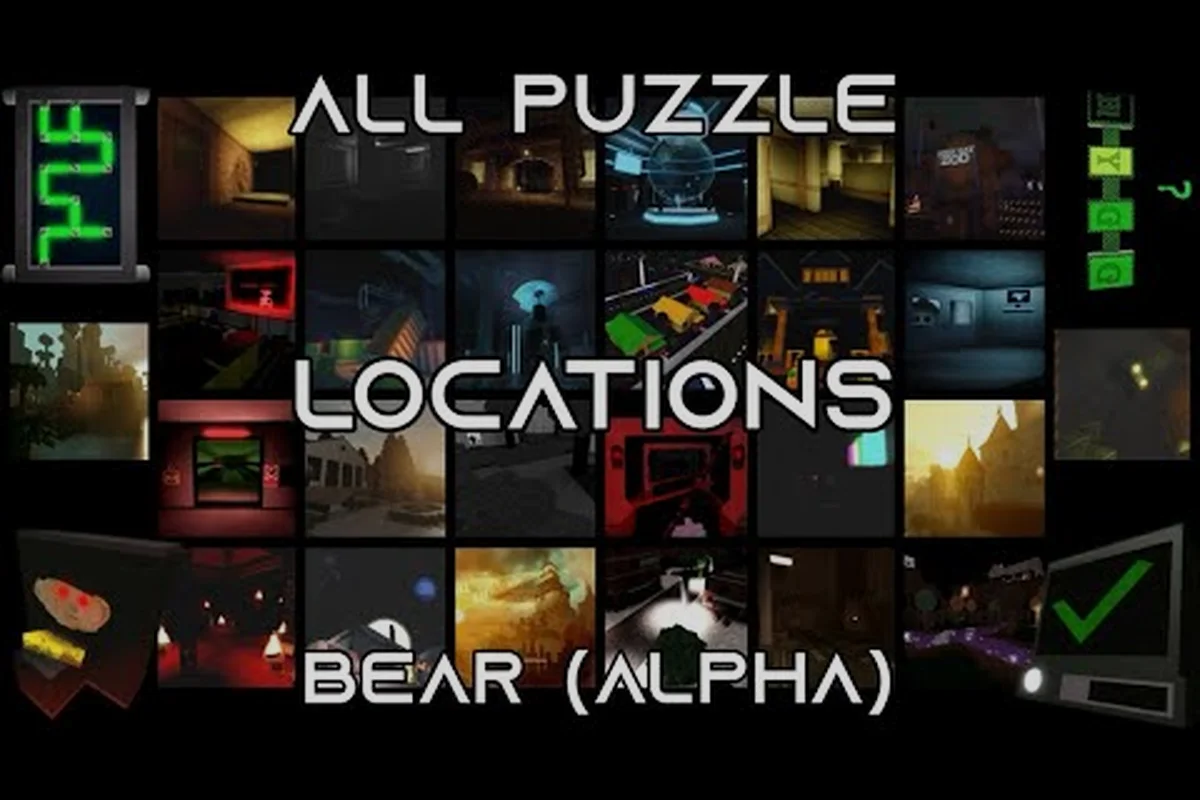
BEAR alpha map memory improves when each route, hideout, and puzzle clue occupies a precise slot in one reference. A useful example is pairing each map with its objective, required puzzle items, and 2026 revamp notes, so finding an anvil in Red Square is not confused with solving the bell puzzle in Swamp Cave. Tracking favorite maps separately from the new maps introduced in 2026 also prevents route confusion after layout changes, while a clear map ranking shows which destinations deserve priority when resources or attempts are limited.
BEAR Alpha Map Memory: A Practical Knowledge Base
Reliable bear alpha map memory depends on more than memorizing landmarks. Players also need to recognize each objective, exit logic, hiding route, and puzzle clue, especially after a map layout changes. The maps listed below provide a structured baseline drawn from verified player videos, including coverage of Assembly, The Lost Tapes, The Final Hour, Happy Terror, and Tears Before Bedtime.
Organizing Maps Into Four Memory Layers
This guide organizes known BEAR (Alpha) maps into four practical layers: purpose, landmarks, objective flow, and memory cues. It is designed for repeat runs rather than a simple listing of level names, because route knowledge works best when each remembered detail has a clear function: an entry landmark confirms orientation, an objective clue explains the next interaction, and an escape option provides recovery if the current route fails. Recording those relationships makes the revamped map easier to relearn after updates without turning the reference into a rigid walkthrough.
| Reference layer | What to remember | Why it helps |
|---|---|---|
| Opening approach | Entry direction and nearby landmarks | Prevents wasted movement at the start of a run |
| Mid-run navigation | Intersections, rooms, and distinctive objects | Keeps the route stable when pressure rises |
| Objective memory | Clues, puzzle pieces, and required interactions | Clarifies what progress looks like |
| Escape memory | Exits, alternate routes, and hiding options | Supports recovery after mistakes |
Community videos by Konos and LanceH78 provide player-reported examples of map and puzzle coverage. Because BEAR (Alpha) lacks an official wiki, treat exact puzzle locations and map details as community observations, especially when updates can move interactable objects. For a broader look at map layouts and progression, the BEAR Alpha map layout reference complements this puzzle-focused guide by showing how objectives, landmarks, and recovery routes fit across the wider map. For example, you can use the four reference layers here to decide whether a distinctive room is an objective clue or simply a navigation landmark, then cross-check its placement in the broader layout. This distinction makes a saved route easier to adapt when the revamped map introduces a new shortcut, changes an interactable location, or forces you to use an alternate exit after a failed puzzle attempt.
Core Maps and Landmark-Based Memory
A strong bear alpha map knowledge guide starts with stable landmarks rather than vague directional instructions. “Turn left near the red object” becomes much easier to apply after you recognize the specific room, silhouette, or route connection associated with that object.
Assembly
Assembly appears repeatedly in player-created map showcases, making it one of the easiest levels to use as a baseline. Treat the initial area as a training ground for recognizing recurring visual language: corridor shape, open spaces, and nearby objects.
| Memory checkpoint | Observation | Action during a run |
|---|---|---|
| Spawn-facing corridor | Note the opening sightline and side branches | Memorize the first route split |
| Main junction | Identify the strongest visual anchor | Use it to orient after a detour |
| Interior rooms | Remember which rooms connect to the junction | Avoid repeating cleared sections |
| Objective area | Connect the objective to the adjacent landmark | Reduce unnecessary backtracking |
A community walkthrough by EndStoneNinja showcases Assembly alongside other featured maps. The video is best treated as a visual reference rather than an official rulebook because the available information comes from player experience.
The Lost Tapes
The Lost Tapes benefits from a sequence-based memory model. Instead of asking only where the exit is, remember what happens between entering the map and reaching the objective. This makes the route easier to reconstruct after an interruption or chase.
The Final Hour
The Final Hour should be studied under pressure. Players need a short route to the objective, one fallback branch, and one escape location they can identify without stopping to inspect every prop. Build those three references separately, because a single crowded landmark may not remain visible during a chase.
Happy Terror
Happy Terror is useful for testing whether you recognize objectives beyond obvious chase routes. Mark the room where progress begins, the object that confirms interaction, and the direction of the next transition. The more visual noise present, the more important those anchors become.
Tears Before Bedtime
Tears Before Bedtime rewards careful route reconstruction. Work from the map entrance toward the objective and then reverse the sequence in your mind. That reverse pass reveals missing links, such as a corridor that looks connected but leads into an unintended loop.
| Map | Best memory method | Core information to retain |
|---|---|---|
| Assembly | Landmark sequence | Junction, objective, exit |
| The Lost Tapes | Ordered route | Clue order and transition rooms |
| The Final Hour | Three-point plan | Objective, fallback, escape |
| Happy Terror | Object association | Visual anchor and puzzle location |
| Tears Before Bedtime | Forward-and-back recall | Route sequence and false connections |
BEAR Alpha Puzzle Locations and Objective Clues
Recording a puzzle location
Community reports identify puzzle-focused runs across the known map set, but exact locations can shift after updates. The dependable approach is to connect each clue to its surrounding environment, not merely memorize a coordinate that may no longer exist. When you discover a puzzle clue, write down three connected details: the object used as the anchor, the nearby color or lighting, and the route leading away from it. A note such as “red switch, two doors past the blue hallway” is more resilient than “switch in the second hallway.”
| Clue type | Memory anchor | Verification habit |
|---|---|---|
| Object interaction | Shape and material | Interact once, then confirm the visual change |
| Environmental symbol | Color and placement | Look for a matching symbol elsewhere |
| Sequence puzzle | Order of operations | Repeat the sequence on the next attempt |
| Hidden route | Landmark and direction | Trace the route backward afterward |
| Exit mechanism | Position plus interaction | Check both nearby branches after activation |
Handling repeated puzzle attempts
Repeated attempts are more efficient when each run has one learning goal. Attempt one focuses on reaching the clue, attempt two focuses on the activation order, and attempt three focuses on escaping with the objective. This staged approach is more useful than memorizing every failed movement in one session. Players have published broad puzzle-location collections, including the LanceH78 puzzle guide video. Treat the visible locations as community reports and verify them in-game, particularly after a patch moves an interactable, changes lighting, or redirects an exit.
What counts as a solid objective cue
A good objective cue is visible before you enter the puzzle room. It may be a distinctive wall object, an unusual sound source, a change in lighting, or a path that only opens after the preceding event. If your clue appears only after the interaction is complete, it cannot help you find the puzzle during the first approach.
| Memory strength | Example | Study method |
|---|---|---|
| Weak | “Somewhere in a side room” | Add color, object, and route details |
| Medium | “Near the broken display” | Add the turn leading into the area |
| Strong | “Left of the damaged cabinet, then one narrow door” | Review the sequence from spawn |
BEAR Alpha Revamped Map Changes in 2026
A bear alpha revamped map can alter more than scenery. Layout adjustments may change travel time, conceal objectives, move puzzle props, or redirect escape paths. The bear alpha new maps 2026 tag is useful for tracking additions, but an addition alone does not guarantee that every earlier route remains unchanged.
Verifying a changed map
Treat community content and in-game observations as separate layers. A player video can document an older version, while a newer run may reveal a relocated prop or changed route. Record the date when you verify a map and revisit any memorized sequence after a major update.
| Change type | Likely memory impact | Best response |
|---|---|---|
| New room or corridor | Changes route length and loops | Re-map entrances and exits |
| Moved puzzle object | Invalidates one exact clue | Memorize a broader surrounding anchor |
| Changed lighting | Alters visibility | Identify shapes rather than relying on color |
| New hiding place | Changes chase recovery options | Record an alternate escape branch |
| Rerouted objective | Changes run order | Revisit the sequence from spawn |
| Cosmetic replacement | Little mechanical impact | Confirm there are no hidden interactions |
How to document a revamped area
Begin with the previous route, then compare it during a fresh run. Note only meaningful changes rather than every visual difference. A concise log should include the old route, the new route, whether the objective moved, and which escape option remains reliable. The CroutonZ map showcase offers another player-reported view of the featured maps. Since it is not official documentation, compare its routes against the current build before using them for high-speed runs.
Handling patch uncertainty
Players should never rely on a remembered route without checking the first junction. Updates can invalidate a clue while leaving the broader map recognizable. Keep a short-term memory layer for patch-sensitive details and a long-term layer for stable landmarks, objectives, and escape logic.
BEAR Alpha Favorite Map and Map Ranking Criteria
Choosing a bear alpha favorite map depends on whether you value speed, puzzle depth, atmosphere, or reliable escapes. A useful bear alpha map ranking should therefore evaluate experience rather than assign a single universal best map. For example, a bear alpha revamped map with faster progression and tighter bear encounters may suit players optimizing run efficiency, while a puzzle-heavy layout rewards careful route planning and knowledge of the bear alpha map knowledge guide. This approach also keeps the bear alpha map ranking relevant to different goals and avoids treating any single map as the definitive choice.
Ranking the featured maps
The following ranking is a practical community-oriented judgment based on how much each map supports a distinct objective, especially the memory demands of Bear Alpha. It is not an official tier list: The Lost Tapes tests clue-order recall, The Final Hour prioritizes chase intensity, Tears Before Bedtime stresses route reversal, Happy Terror separates puzzles from distractions, and Assembly rewards learning a recognizable baseline layout. Preferences will vary by player skill, group size, and how consistently players can remember environmental details.
| Rank | Map | Strongest quality | Main learning challenge |
|---|---|---|---|
| 1 | The Lost Tapes | Objective depth | Remembering clue order |
| 2 | The Final Hour | Chase intensity | Building a fast escape plan |
| 3 | Tears Before Bedtime | Atmosphere | Reversing complex routes |
| 4 | Happy Terror | Visual unpredictability | Separating puzzles from distractions |
| 5 | Assembly | Approachability | Recognizing the baseline layout |
Choosing your personal favorite
Give each map a score from one to five in four categories: navigation clarity, puzzle complexity, escape reliability, and atmosphere. Add them for a total out of twenty. This method makes the bear alpha favorite map decision more personal than choosing based only on difficulty or popularity.
If the goal is learning the game rather than chasing records, Assembly offers the gentlest foundation because its visual reference points make navigation, puzzle sequencing, and escape routes easier to internalize. Players who enjoy deduction may prefer The Lost Tapes, where layered objective logic requires tracking clue sequences, while those who want a concise survival plan can focus on The Final Hour and practice immediate route decisions under chase pressure.
| Player priority | Best map to study | Reason |
|---|---|---|
| Learn core navigation | Assembly | Establishes visual reference points |
| Master clue sequences | The Lost Tapes | Offers layered objective logic |
| Improve chase recovery | The Final Hour | Rewards immediate route decisions |
| Enjoy exploration | Tears Before Bedtime | Encourages detailed route memory |
| Handle visual distractions | Happy Terror | Tests landmark filtering |
For deeper route and spawn information, the hardest map strategy reference is particularly useful when your favorite depends on surviving pressure rather than solving puzzles quickly. Use it to compare spawn patterns, chase behavior, and escape routes, then relate those findings to your four-part map score: a map with reliable recovery may earn points for escape reliability even when its navigation clarity is weaker. This makes the bear alpha map knowledge guide more practical for players comparing Assembly, The Lost Tapes, The Final Hour, and other maps by remembered routes rather than by difficulty alone.
A Repeatable BEAR Alpha Map Practice Routine
Map knowledge improves when each run has a purpose, so structure practice around distinct objectives rather than repeated aimless rounds. Random play can reveal routes and interactable objects, but targeted repetition is what turns those observations into dependable bear alpha map memory. For example, one circuit may focus only on memorizing puzzle-room layouts, while another tests escape-planning routes and map-object locations under a time limit. Short drills that isolate navigation, puzzles, and escape planning make gaps visible, helping you recognize landmarks, remember room connections, and reconstruct the map instead of merely gaining surface-level familiarity.
First run: landmark recognition
Ignore speed and identify the opening route, major junction, and objective anchor. Walk through the map as if describing it to another player without using color alone. This catches weak visual cues that disappear when the interface or lighting changes.
Second run: puzzle recall
Attempt only the objective route. Before interacting with the first clue, name the expected object and its surrounding marker. After each puzzle, predict where the next objective should appear. Comparing predictions with the actual route reveals which clues need stronger anchors.
Third run: escape and recovery
Begin with a deliberately slow route, then simulate pressure by choosing the shortest available path after the objective. Record two escape branches rather than one. The BEAR Alpha overall guide can help connect map study with broader survival habits, but the escape drill should remain specific to each level.
| Drill | Target | Completion standard |
|---|---|---|
| Landmark sweep | Visual recognition | Name three anchors without minimap help |
| Puzzle prediction | Objective logic | Predict the next clue before entering |
| Backward trace | Route understanding | Rebuild the path from objective to spawn |
| Escape pair | Chase recovery | Identify two working exits |
| Patch check | Update awareness | Verify objectives and junctions again |
Building personal landmark cues
Useful cues combine one stable feature with one action. “The cracked cabinet opens the passage” is stronger than “the cabinet room,” because it connects the object to its purpose. Avoid relying solely on color, because lighting changes can make otherwise identical rooms look different.
Measuring improvement
Track completion time, number of wrong turns, and number of repeated puzzle attempts separately. A faster run caused by skipping objectives is not progress. The best measurement is consistent completion with fewer detours and a clear route back to safety.
Keeping notes useful
Use one line per checkpoint and include the relationship between landmarks. A compact note such as “broken cabinet → narrow corridor → objective room” is easier to replay than a paragraph of vague observations. Revisit notes after updates and mark anything that has changed as unverified.
Verifying a Map Is Fully Memorized
Before calling a map memorized, confirm that you can explain its opening route, objective sequence, puzzle clues, and recovery plan. The goal is not to memorize a still image; it is to recognize the next useful location while the world around you changes.
Mastery checklist
-
Route recall: You can reach the objective without revisiting a cleared junction.
-
Puzzle recall: You can associate each clue with a nearby visual anchor.
-
Escape recall: You know at least two exits or branches from the objective area.
-
Update awareness: You know which locations came from community reports and need verification.
-
Run comparison: You compare each attempt with the previous route instead of repeating the same mistake.
| Knowledge level | Description | Next action |
|---|---|---|
| Recognition | You know major landmarks | Practice route order |
| Navigation | You reach objectives reliably | Improve escape branches |
| Puzzle mastery | You solve clues without repeated searching | Test under pressure |
| Speed memory | You complete the route quickly | Verify after every update |
Strong bear alpha map memory comes from organizing landmarks, objectives, and exits into a repeatable mental model. Use this reference as the baseline, verify community locations against the current build, and keep your favorite map ranking grounded in the qualities you actually want from each run.
Frequently Asked Questions
What are the main maps in BEAR Alpha?
Community showcases commonly identify Assembly, The Lost Tapes, The Final Hour, Happy Terror, and Tears Before Bedtime. These are the clearest featured set for building a bear alpha map knowledge guide, although individual updates may add or revise areas. Players should verify the current map list in-game because no official wiki is available.
Which BEAR Alpha map is best for beginners?
Assembly is generally the most approachable starting point because it provides a simpler baseline for learning landmarks and route structure. The Lost Tapes and Tears Before Bedtime offer deeper puzzle or atmosphere challenges. For broader preparation, the beginner guide can explain how maps fit into the wider gameplay loop.
How can players remember puzzle locations in BEAR Alpha?
Record three details for every clue: the interactable object, a nearby visual anchor, and the route leading toward it. Avoid relying only on a color or room number. Repeating the puzzle on a second run is essential because objects can move during updates, so community locations should be treated as reports rather than permanent facts.
Did BEAR Alpha receive new or revamped maps in 2026?
Player discussions and videos indicate continuing interest in the 2026 map roster, including the featured set of Assembly, The Lost Tapes, The Final Hour, Happy Terror, and Tears Before Bedtime. Exact additions and revisions can vary by version, so check in-game announcements and compare current routes with older community videos before assuming a bear alpha revamped map retained its original layout.
What makes a strong bear alpha map ranking?
A useful ranking scores navigation clarity, puzzle complexity, escape reliability, and atmosphere. This produces a more meaningful comparison than choosing one map for every player. The Lost Tapes may suit puzzle specialists, while Assembly offers the cleanest learning curve, and The Final Hour rewards players whose favorite challenge is immediate movement under pressure.